
AI is moving faster than we're adopting it
With Eneric Lopez, Director of AI & Social Impact, Microsoft France
-

-
- Innovation Leaders
-
Published in Innovation Leaders Podcast, AI
AI is spreading rapidly. But what does that actually tell us about the way organisations are changing?
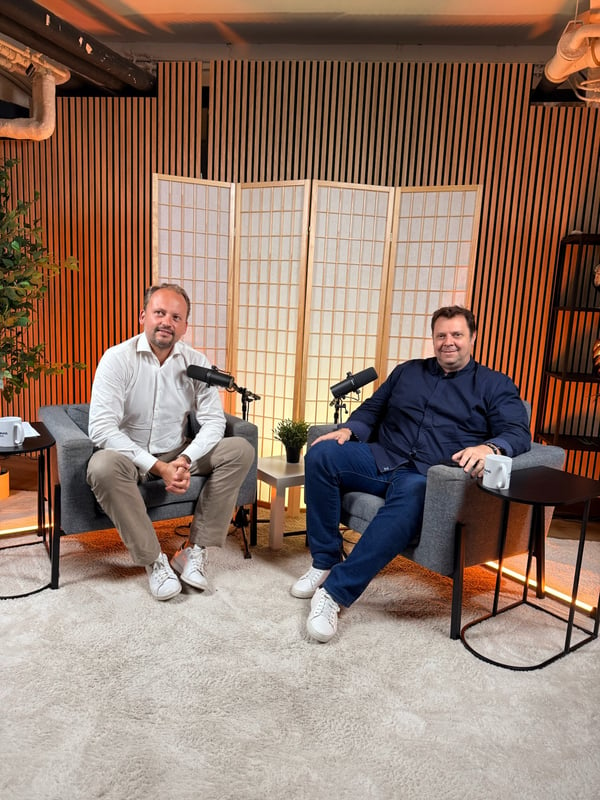
In Episode 81 of Innovation Leaders, Geoffrey Behaghel speaks with Eneric Lopez, Director of AI & Social Impact at Microsoft France, about what comes after AI adoption: identifying meaningful use cases, building AI literacy, transforming business processes and keeping human expertise at the centre.
Recorded in French. This editorial recap brings together the key ideas, perspectives and references from the conversation for our international audience.
AI diffusion is shaped by more than technology
One of the first points Eneric makes is that the growing use of AI does not necessarily mean organisations have transformed.
He discusses a Microsoft research report, produced by the AI For Good Lab and the AI Economics Institute , that measures diffusion, not usage or adoption. Diffusion, in this study, means the share of people aged 15–64 using generative AI for at least 90 minutes a month. On that measure, France ranks fifth globally, ahead of the United States.
But diffusion is only part of the story. Eneric points to differences in connectivity, access to networks, language representation in AI, access to training, and public policy as factors that can encourage or limit diffusion, along with a continuing gap between the Global North and South. He notes, for instance, that despite hosting the world's leading AI labs, the US doesn't necessarily lead on diffusion, pointing to fragmentation between states and uneven connectivity as contributing factors.
This is why a country's position in a ranking should not be read as a simple measure of AI maturity. Diffusion tells us people are using AI; it doesn't tell us how they're using it, whether that use is professional or personal, or whether AI has become embedded in the way organisations actually operate.
That leads to a more interesting question: when does AI adoption become transformation?
For Eneric, transformation happens when practices, tools and business processes actually change — when organisations start working differently because of it.
« On est dans ce passage entre adoption et transformation. »
We're at the point between adoption and transformation. (16:46)
From FOMO to FOBO: the organisational challenge
Eneric describes most organisations today as caught between two pressures. On one side, FOMO — Fear of Missing Out — the instinct not to miss the AI wave, even before knowing exactly how to get started or what the return on investment will be. On the other, FOBO — Fear of Being Obsolete — the anxiety, more common among individuals, that AI might replace them.
« Le FOBO, Fear of Being obsolète. Est-ce que l'IA va me remplacer ? »
FOBO: Fear of Being Obsolete. Will AI replace me? (14:57)
For organisations, the real question becomes: how do we move towards AI while bringing everyone with us — addressing the executive committee's push for use cases and ROI, and the individual's fear of obsolescence, at the same time?
Start with the problem, not the technology
For organisations trying to make that transition, Eneric argues the starting point should not be AI itself. It should be the business problem.
Rather than asking "what can I do with AI?", he suggests starting with the pebble in the shoe: what problem do I actually have in my work or daily life?
« La vraie bonne question, c'est partir du caillou dans la chaussure. Qu'est-ce que c'est la problématique que j'ai dans mon métier, dans mon quotidien ? »
The real question is to start with the pebble in the shoe. What's the problem I have in my job, in my daily life? (17:59)
Only once that problem is named does it make sense to ask whether a technology — generative AI, in this case — could help solve it. This distinction matters because the availability of increasingly powerful tools can easily push organisations to search for problems that fit the technology, rather than the other way round.
The companies moving furthest in this direction, he explains, are going beyond individual productivity use cases and beginning to anchor AI in their core business functions — becoming what he calls "frontier firms."
AI literacy needs to go beyond leadership
Technology is only one part of the transition. Throughout the conversation, Eneric returns to training and AI literacy as fundamental requirements — not just for executives, but for every employee.
This is why Microsoft has committed to training one million French citizens in AI, including employees at small and medium-sized businesses. For Eneric, people need enough understanding to avoid two extremes: blindly embracing every new AI capability, or assuming the technology will simply replace them. That balance — informed rather than fearful or blindly enthusiastic — is what he means by "citoyens éclairés," or informed citizens.
Shadow AI: when experimentation moves faster than organisations
That question becomes particularly relevant with Shadow AI: employees using AI tools independently because the organisation hasn't yet provided the tools or framework they need.
Eneric sees this as both a challenge and an opportunity. Employees are already experimenting; the question is whether organisations can create an environment where that experimentation happens securely, within a framework, and in a way that's useful. The conversation moves toward enterprise AI, internal GPTs and AI agents — tools organisations can build to give people what they need while keeping control over their data and systems.
But again, the technology isn't the end goal. The real opportunity comes when those tools become part of actual business workflows.
From generative AI to agents
Another shift discussed in the episode is the move from generative AI toward agentic solutions. Through programmes like Gen AI Studio — now in its third edition, and built with an ecosystem of partners rather than Microsoft alone — Eneric has watched startups evolve from using generative AI for specific tasks to building agents that work across a whole workflow.
For Eneric, this is also where startups have a distinct role to play: not simply building another layer on top of an existing model, but developing specialised solutions that understand a particular business problem in depth.
The risk of cognitive debt
Perhaps the most human part of the conversation comes when Eneric addresses what AI means for our own thinking. He refers to a controversial MIT study — small sample, contested methodology, but widely discussed — on cognitive debt: the idea that relying too heavily on generative AI can mean we retain less of the knowledge or thinking we'd otherwise have developed ourselves.
His answer isn't to reject AI. It's to use it critically — thinking first, forming our own ideas, and identifying the questions we want to explore before turning to AI to help develop them further.
« On doit rester, on a besoin d'être expert dans son domaine avant d'utiliser l'IA générative, donc musclons notre expertise, cultivons notre expertise. D'ailleurs, au passage, l'IA peut nous aider à être encore plus expert dans notre domaine. »
We need to remain experts in our field before using generative AI. So let's strengthen and cultivate our expertise. And, incidentally, AI can help us become even more expert in our field. (44:08)
This is why he argues we need to remain experts in our fields before using generative AI — rather than replacing expertise, AI can help amplify it, provided we stay critical of how we use it.
The human skills that matter
As technology becomes more capable, Eneric argues that skills like creativity, collaboration, compassion, critical thinking and strategic thinking may matter even more, not less. Rather than fearing replacement, he frames this as an opportunity: AI as technology that amplifies our humanity, not a substitute for it.
Keep experimenting
Eneric's closing advice has no single tool or routine attached to it. Someone may try a generative AI tool once, get an underwhelming result, and decide AI isn't useful to them — but the problem is often that they haven't yet found the right use case, or experimented enough to learn how to fold it into their everyday work.
« Continuer à expérimenter et à se tenir au courant, et continuer à apprendre. »
Keep experimenting, keep up to date and keep learning. (1:08:25)
Conclusion
The central message of the conversation is simple: AI diffusion is not the same as AI adoption, and AI adoption is not the same as transformation.
Transformation happens when organisations move beyond experimenting with tools and start changing their processes, functions, culture and ways of working.
The challenge is no longer simply getting people to use AI. It is learning how to make it genuinely useful — while keeping human expertise, judgement and creativity at the centre.
Resources mentioned in the conversation
- Open to Work — Ryan Roslansky & Aneesh Raman. A book about how work and skills are evolving in the age of AI.
- À vous l’IA.fr — A free, technology-agnostic platform co-developed with Simplon to explore AI use cases.
- Gen AI Studio — Microsoft France's accelerator programme for generative AI and agentic solutions.
- AI Factory — Microsoft France's AI accelerator launched alongside Station F.
- Citizen AI — Initiative focused on understanding generative AI.
- Parents IA — Resources helping parents understand generative AI and discuss it with their children.
- Cognitive debt — The concept discussed in the episode around the risks of over-relying on generative AI.
- Relational economics — A concept discussed through Aneesh Raman's work on the growing importance of human relationships.